
How To Find Your Property On FEMA’s Flood Insurance Rate Maps

What are FEMA flood maps?
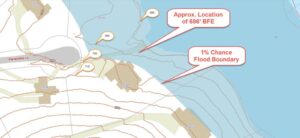
FEMA’s Flood Insurance Rate Maps (FIRMs) or just Flood Maps are provided after a flood risk assessment has been completed or updated for a community.  This study is known as a Flood Insurance Study.  The FIRM gives you the Base Flood Elevations (BFEs) and insurance risk zones in addition to floodplain boundaries.  The FIRM may also show a delineation of the regulatory floodway.

Once the “insurance risk zone”  (commonly referred to as the flood zone) is determined, actuarial rates, based on these risk zones, are then applied for newly constructed, substantially approved, and substantially damaged buildings.  FEMA uses these rates to determine the insurance rate you will pay for flood insurance

FEMA’s Digital Flood Maps

FEMA discontinued the production and distribution of paper flood maps in 2009 as part of its Digital Vision Initiative. This affected all the Flood Maps, boundary information, and study reports. However, clients can still view the products for free through their website or buy them in digital format.

To view these flood maps online, go to FEMA’s Map Service Center and key in your address (hi-lited area shown here) search for your home.  This will prompt you to then select the map that covers your area.  The Flood Maps are somewhat cumbersome to use online. It is best to go through the tutorial on the bottom right of the address search page for an easier and more effective use of the GIS map.

author avatar
Surveyor

More Posts

Licensed land surveyor performing a topographic survey before adding fill dirt to map elevations and drainage patterns for a residential grading project
land surveying
Surveyor

Before Bringing in Fill Dirt, Start With a Topographic Survey

Fill dirt looks simple. You order a load, spread it out, and fix that low spot in your lot. But in Indianapolis, that quick fix can backfire fast. Marion County soil doesn’t drain the way builders expect. Add fill in the wrong spot, at the wrong depth, and water starts

Read More »
A surveyor uncovers missing property line markers in a residential yard while a homeowner watches nearby
boundary surveying
Surveyor

Property Line Markers Missing? Here’s Where Surveyors Start

You bought a lot. You want to build a fence, a shed, or a driveway extension. You go looking for the metal pins or stakes that mark your property corners. They’re gone. This happens more than people think. Markers get buried, mowed over, or pulled out by accident. The good

Read More »
Contractors reviewing a plat of survey while planning residential construction before breaking ground
land surveying
Surveyor

Plat of Survey Details Contractors Review Before Breaking Ground

A plat of survey helps contractors know what they are working with before they break ground. It shows what is already on the lot, how water drains, where utilities connect, and how tight the access points are. Contractors who review it early avoid problems that cost time and money later.

Read More »
Licensed land surveyor reviewing a newly completed construction site with survey equipment during an as-built survey inspection
land surveying
Surveyor

As-Built Surveys Explained for Homeowners and Builders 

When building work ends, one step is still left. As built surveys must be done before permits close out. They must also be done before the last loan payment. This survey shows what was built, where it sits, and if it matches the set plans. What Is an As-Built Survey?

Read More »
Storm-damaged fence panels lying on the ground in a backyard after strong winds, with the property boundary no longer clearly visible
land surveying
Surveyor

How to Find Property Lines After Storm Damage

A strong storm can change your yard overnight. One day, everything looks normal. The next day, a tree is down, your fence is gone, and debris is spread across the ground. You step outside ready to clean up. Then you stop. Where does your property actually end? This is where

Read More »